Want to work together? Reach out >
'It feels so much easier': Removing friction from insurance purchases
Portcullis
Shipping insurance for UK military personnel, 2026
Updated: 5 September 2026
Want to see it firsthand?

Full story
Summary
Visuals
Military personnel need reassurance that their goods have effective coverage when moving between posts.
I defined the UX and visual principles that turned a plain policy purchase, into a simple journey for the user, rebuilding it from the ground up to make a vague product feel precise, and more trustworthy.
The work was split into three goals:
Restructuring the architecture around how users actually acquire their insurance, by making the service responsive.
Creating a scalable design system and component library, to bring consistency across the product.
Rethinking the payment flow to remove friction and improve conversion.
'Oliver worked with precision, making Portcullis so much more accessible and straightforward to use.'

Daniel Johnson
Broking Director, Basil Fry & Company

Portcullis now uses friendlier language and imagery to gain trust.
Understanding the problem of relocating
51%
of those who moved were negative about the number of moves they experienced.
20%
service families relocate annually.
15%
of service families relocate at least 3 times in 5 years.
UK military families find the frequency of their relocations difficult. Source: GovUK
Frequent relocation creates a recurring insurance need, but conventional insurance isn't necessarily designed around the realities of military life.
The MOD advises personnel to take out private insurance for risks not fully covered by public funds, while military family organisations report that finding suitable cover can be difficult.
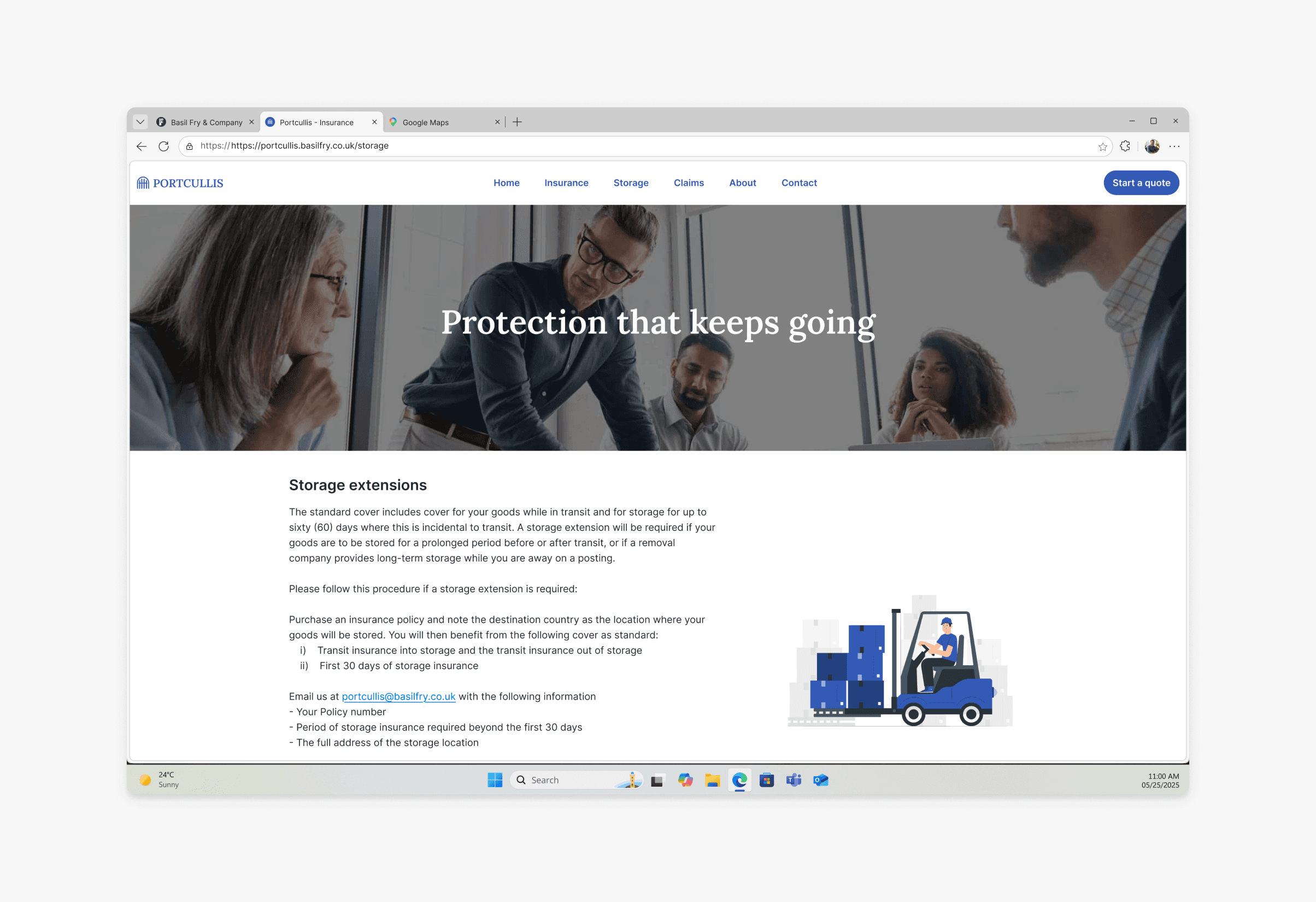
Before the redesign, users weren't directed through the purchasing journey.
Working with constraints
Before getting into how I designed Portcullis, it helps to understand what I was designing within.
An uncertain customer-base. Purchasing insurance is something that requires immense levels of trust, so creating a product that maximised reassurance was paramount to it's success.
Data protection. Portcullis clients are members of the UK military, and the protection of their identities and personal information was vital.
Sole designer. I was the only designer throughout, so the same desk handled every screen, flow, research call, and brand asset.
Checkout conversions with wallet payments
0%
25%
50%
75%
100%
77%
Apple Pay accepted
Apple Pay not accepted
Mobile payments are increasingly popular. A YouGov survey revealed that 21% of UK adults have used Apple Pay or Google Pay, with 56% of those who haven’t are keen to try them.
A study by PYMNTS found that UK merchants that accepted Apple Pay had an average conversion rate of 77%, compared to 54% for those who did not.
With these statistics in mind, I completely revamped the checkout flow and payment process, tailoring it towards simplicity, and ease of payment; by doing so, friction was reduced leading to easier use.

Users now find the payment process easier, and more reassuring.
Visual feedback and follow-ups
Before getting into how I designed Portcullis, it helps to understand what I was designing within.
An uncertain customer-base. Purchasing insurance is something that requires immense levels of trust, so creating a product that maximised reassurance was paramount to it's success.
Data protection. Portcullis clients are members of the UK military, and the protection of their identities and personal information was vital.
Sole designer. I was the only designer throughout, so the same desk handled every screen, flow, research call, and brand asset.
'Our clients now find the process of buying a policy with Portcullis easier than before.'

Raven Bruce
The outcomes
Checking out is now on average 48% faster following the updates to the payment page, and integration of wallet payment methods.
With a clear identity and design system, Portcullis can be updated if content needs changing in the future.
As a responsive service now, users can access the product on mobile or tablet, allowing them to purchase policies anywhere.